
Table of Contents
- How to Apply Perfume Correctly: The 7-Step Routine
- Where to Apply Perfume: Pulse Points and Warm Areas
- How Many Sprays of Perfume to Use by Concentration
- Should You Spray Perfume on Clothes? Fabric, Hair, and Safety
- How to Make Perfume Last Longer All Day
- Common Application Mistakes and How to Fix Them
- Applying Fragrance in Shared or Scent-Sensitive Spaces
- Conclusion: Build a Fragrance Routine That Works for You
- Frequently Asked Questions
Last Updated: October 15, 2026
How to Apply Perfume Correctly: The 7-Step Routine
Learning how to apply perfume correctly comes down to timing, placement, and patience.
This guide breaks down a simple 7-step routine. It takes about two minutes and can help your fragrance last hours longer.
Here is the short version: start with clean, moisturized skin, apply to pulse points, and never rub. Below, we walk through each step in detail.
- Step 1: Clean, moisturized skin
- Step 2: Spray or dab at pulse points
- Step 3: Let it dry, do not rub
| Step | What to Do | Time | Why It Matters |
|---|---|---|---|
| 1 | Moisturize skin | 30 seconds | Holds scent longer |
| 2 | Apply to pulse points | 20 seconds | Body heat releases scent |
| 3 | Let it dry, no rubbing | 1 minute | Protects the top notes |
| 4 | Cover warm areas | 20 seconds | Better diffusion |
| 5 | Match sprays to strength | 10 seconds | Prevents overapplication |
| 6 | Test on fabric first | 10 seconds | Avoids stains |
| 7 | Reapply lightly | 10 seconds | Keeps scent fresh |
Step 1: Start With Clean, Moisturized Skin
Dry skin loses fragrance fast; moisturized skin holds it. Apply an unscented lotion right after your shower, wait a minute, then spray. Many people skip this step, but it is the easiest fix for weak, short-lived perfume.
Step 2: Spray or Dab at Pulse Points
Pulse points are the warm spots where you can feel your heartbeat; body heat there pushes the scent into the air. Spray from about 6 inches away, or press gently if using a roll-on or dab format.
Step 3: Let the Fragrance Dry Without Rubbing
Rubbing your wrists crushes the top notes. You lose the bright opening. What is left smells flatter.
Spray, then wait. Let it dry on its own. That single habit changes how long your scent lasts.
Where to Apply Perfume: Pulse Points and Warm Areas
Where you apply perfume matters as much as how much you use. But the popular explanation, that warmth opens your pores and scent pours out, is only half right. Here is what is actually happening.
What Pulse Points Actually Do
A pulse point is a spot where an artery runs close to the skin's surface: the inner wrist, side of the neck, temple, behind the ear, inner elbow, groin, behind the knee, ankle.
Two things make these spots useful for fragrance:
- They run slightly warmer than surrounding skin. That mild warmth raises the evaporation rate of the alcohol and aroma compounds in your perfume, so the scent lifts off the skin a little faster and reads a little stronger.
- They are thin-skinned and well-supplied with blood. Fragrance sits closer to the surface, so it diffuses more readily than on thick, dry areas like the palms.
What warmth does not do: it does not "open your pores" to absorb perfume or push scent out of your body. Fragrance evaporates from the skin's surface; pores are openings to hair follicles and sweat glands, not scent vents.
Why This Matters for Placement
Because the mechanism is evaporation, not absorption, a few rules follow:
- Warm, thin-skinned spots amplify. Wrists, neck, and behind the ears project more than the forearm.
- Cool, dry, thick-skinned spots mute. Palms, soles, and the backs of the hands hold scent poorly.
- Movement spreads it. Inner elbows and behind the knees release scent as you move, giving a soft trail rather than a concentrated cloud.
The Main Spots, Ranked by Effect
- Inner wrists, warm, thin-skinned, easy to reach. Strong projection. Apply lightly; this is where most people overdo it.
- Side of the neck and hollow of the throat, the classic spot. Warm and close to the face, so you smell it yourself all day.
- Behind the ears, thin skin, mild warmth, and it sits near the hairline, which helps the scent linger.
Your skin temperature drives diffusion: warm areas push scent outward faster, cool dry areas hold it back. That is the whole mechanism, no pores required.
Wrists, Neck, and Behind the Ears
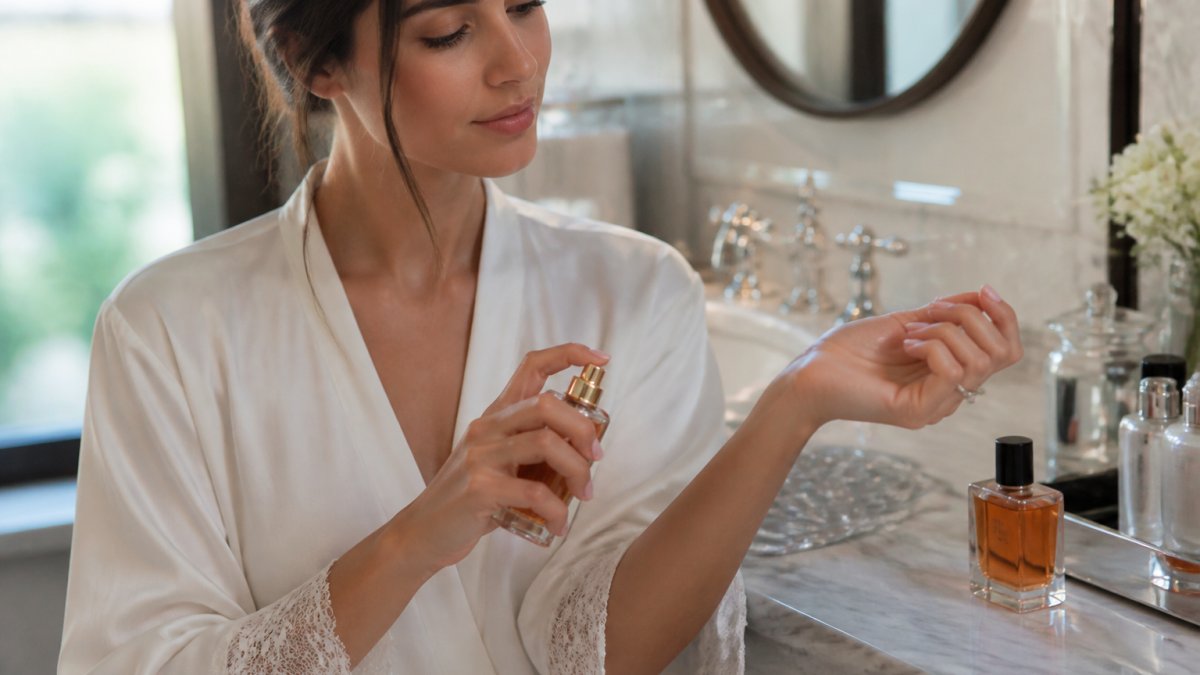
The inner wrist and hollow of the neck are the classic spots, warm and easy to reach. Behind the ears works well too, since the skin is thin and warm; a light touch is enough. Do not press your wrists together after spraying, that is rubbing in disguise and crushes the top notes.
Inner Elbows, Abdomen, and Behind the Knees
These spots are often forgotten but work well. The inner elbow and behind the knees are warm and give off scent as you move, while the abdomen is a good choice under clothing. Apply lower for a softer trail, higher for a stronger cloud near the face.
How Many Sprays of Perfume to Use by Concentration
How many sprays of perfume to use depends on the formula's concentration and format. Stronger formulas need fewer sprays, lighter ones more, but a spray count only helps if you are actually spraying, since oils, dabbers, and solids are dosed differently.
Starting Amounts by Concentration
| Concentration | Typical Strength | Sprays to Start |
|---|---|---|
| Parfum | Strongest | 1 |
| Eau de parfum | Strong | 2 |
| Eau de toilette | Medium | 3 |
| Eau de cologne | Light | 4 |
| Body mist | Lightest | 5 or more |
Start low, you can always add, but you cannot take it back. Overapplication overwhelms the room and dulls your own nose to the scent.
Dosing by Format, Not Just Concentration
A spray count assumes a spray bottle. Most fragrance also comes as oil, dabber, or solid, and each delivers a different amount per application.
- Spray (eau de parfum, eau de toilette, cologne, mist): One spray is roughly a fixed dose. Use the table above as your starting point.
- Roll-on perfume oil: Oils are concentrated and low in alcohol, so they sit close to the skin and last longer but project less. Start with a single swipe on one pulse point, not a full pass over several. Two swipes total is plenty for most people.
- Dabber or splash bottle: You control the dose by how much you tip out. Touch the stopper to one pulse point and press, do not pour into your palm and smear. One touch per spot, two spots maximum to start.
If you switch formats, re-calibrate. A person who wears two sprays of eau de parfum should not assume two swipes of oil is equivalent, the oil will usually read stronger up close and last longer.

Skin Sensitivity and Safe Application
Fragrance is a common cause of skin irritation and contact allergy, and risk rises with concentration and amount applied. A few habits keep application comfortable:
Vanilla Jasmine Fragrance Spray, Behind The Ears Neck Wrist Natural Fresh →
- Patch test new fragrances. Apply a small amount to the inner forearm and wait 24 hours before wearing it on your neck or chest. This is the standard way to catch a reaction before it spreads.
- Keep it off broken or freshly shaved skin. Alcohol-based sprays sting on razor burn and small cuts, and irritated skin absorbs and reacts more readily.
- Avoid the eyes, lips, and mucous membranes. Spray away from the face, not toward it. If you want scent near the face, apply to the wrists or behind the ears and let it travel, never spray directly at your neck and face.
If you develop a persistent rash, itching, or swelling after applying fragrance, stop using it and see a healthcare provider. A dermatologist can help identify whether the reaction is to the fragrance itself or to a specific ingredient.
Should You Spray Perfume on Clothes? Fabric, Hair, and Safety
You can spray perfume on clothes, but test first, silk, leather, and light colors are the riskiest. Spray from a distance and let it dry; a light mist on a scarf or coat can carry scent for days.
Fragrance Galore carries a Vanilla Jasmine Fragrance Spray built as a multi-use formula. It works on skin, hair, and fabric.

How to Make Perfume Last Longer All Day
To make perfume last longer, target the skin first. Moisturize, apply to pulse points, and store your bottle away from heat and light.
More ways to extend wear:
- Apply right after a shower, when skin is still damp
- Layer with a matching body lotion or oil
- Keep the bottle in a cool, dark spot
- Carry a small rollerball for touch-ups
A roll-on format is easy to carry. Fragrance Galore's Vanilla Musk Roll-on Perfume Oil is a compact option for a mid-day refresh.
Common Application Mistakes and How to Fix Them
Most weak-scent complaints trace back to a few habits, and the fixes are quick:
- Rubbing wrists → Let it dry on its own
- Spraying on dry skin → Moisturize first
- Too many sprays → Cut the count in half
- Spraying too close → Hold the bottle 6 inches away
Together, these small fixes change your whole fragrance routine.
Applying Fragrance in Shared or Scent-Sensitive Spaces
Strong scent is not welcome everywhere. Offices, clinics, and small rooms call for a lighter touch.
Some people have fragrance allergies or sensitivity (pubmed.ncbi.nlm.nih.gov). Keep your scent close to the skin in shared spaces.
A good rule: one or two light sprays, applied before you leave home.
For scent-sensitive settings, a subtle scent beats a bold one.
Conclusion: Build a Fragrance Routine That Works for You
The right routine is the one you will actually follow. Clean skin, a couple of sprays at pulse points, and no rubbing gets you most of the way.
Our Charm Perfume and Women's Rollerball Perfume are designed for easy, precise application.

Add to cart and find the scent that fits your daily ritual.
Frequently Asked Questions
Should you rub your wrists together after applying perfume?
No. Rubbing wrists together creates friction and heat that can break down the fragrance's top notes, causing it to fade faster and smell different than intended. Instead, spray or dab the perfume on one wrist, then gently press it against the other wrist without sliding. Let the scent air-dry naturally. This technique helps the fragrance develop through its top, heart, and base notes as the perfumer designed, giving you longer wear and a more accurate scent experience.
How far away should you spray perfume?
Hold the bottle about 3 to 6 inches from your skin and spray directly onto pulse points. For an all-over body mist effect, hold the bottle 6 to 8 inches away and spray in a sweeping motion, or mist into the air and walk through the cloud. Spraying too close concentrates the fragrance in one spot, while spraying too far wastes product and reduces longevity. The right distance ensures even coverage without overapplication.
Can you spray perfume in your hair?
You can, but with care. Alcohol-based perfumes can dry out hair over time, so spray from at least 6 inches away or mist onto a brush before running it through. Better yet, use a fragrance specifically formulated for hair, such as the Vanilla Jasmine Fragrance Spray ($35.72) from Fragrance Galore, which works as a body mist, hair fragrance, and room spray. Hair holds scent well because its porous structure traps fragrance molecules.
Should you apply perfume to moisturized skin?
Yes. Moisturized skin holds fragrance significantly longer than dry skin because hydrated skin cells trap scent molecules more effectively. Apply an unscented lotion or moisturizer right after showering, then spray your perfume while the skin is still slightly damp. This creates a base that slows evaporation. Dry skin types benefit most from this step, as their skin tends to release fragrance faster. Pairing with a matching body oil or roll-on perfume oil can extend wear even further.


