
Last Updated: October 23, 2026
Quick Summary
A signature scent is a fragrance you wear regularly that becomes part of your personal identity and that people recognize when you walk into a room. Finding yours requires testing multiple fragrances on your skin for at least eight hours to see how they develop, since fragrance behaves differently on every person based on body chemistry, temperature, and diet.
- Test fragrances on your skin for a full 8-12 hours, not on paper strips, because your unique skin chemistry changes how scents smell and develop.
- Fragrances have three layers: top notes that fade in 5-15 minutes, heart notes that emerge after 15 minutes to 2 hours, and base notes that last longest and determine longevity.
- Wait 2-3 days between testing different fragrances to let your nose reset and avoid olfactory fatigue that prevents accurate smelling.
- Start with sample sets or discovery sets before buying full-size bottles to avoid spending money on fragrances that don't work with your skin chemistry.
- Apply fragrance to warm pulse points like wrists, inner elbows, neck, or behind ears, and moisturize your skin first to help fragrance last longer.
Table of Contents
- What Makes a Signature Scent Right for You
- Understanding Fragrance Families and Notes for Beginners
- How to Find the Right Perfume for Yourself
- How to Test Perfume on Skin: A Practical Protocol
- How to Make Perfume Last Longer and Project Better
- Budget-Smart Discovery and Avoiding Purchase Regret
- Common Mistakes When Choosing a Signature Scent
- Frequently Asked Questions
What Makes a Signature Scent Right for You
A signature scent is a fragrance you wear regularly that becomes part of your personal identity, the scent people recognize when you walk into a room.
At Fragrance Galore, we help discerning individuals discover their perfect signature scent. The right choice depends on three things: your taste, your skin chemistry, and how you test before committing to a full bottle.
Most people choose a signature scent for the wrong reasons.
The fix is simple: test intelligently before you buy. Sample multiple fragrances across several days, wear each for at least eight hours, and note how it opens, evolves at midday, and smells by evening.
Understanding Fragrance Families and Notes for Beginners
Fragrances are organized into families based on their dominant characteristics. Learning them helps you narrow your search and discover scents you'll actually love.
The Core Fragrance Families
Floral fragrances center on flower notes like rose, jasmine, peony, or gardenia, ranging from light and fresh to rich and sensual.
Citrus fragrances feature bright, zesty notes from lemon, bergamot, grapefruit, or orange.
Woody fragrances use base notes like sandalwood, cedarwood, vetiver, or oud.
Spicy fragrances incorporate notes like cinnamon, clove, cardamom, or pepper. They feel warm and sensual, pairing well with cooler months and evening occasions.
Fresh fragrances include aquatic, ozonic, and green notes that smell like water, air, or plants.
Amber fragrances use warm, resinous notes like amber, vanilla, and musk.
Try fragrances from multiple families. You might love woody scents for winter and citrus for summer, or find one family that speaks to you year-round.
Top, Heart, and Base Notes Explained
Every fragrance has a structure built from three layers of notes. Understanding it helps you predict how a scent will behave on your skin.
Top notes are what you smell in the first 5-15 minutes, usually bright, zesty, or fruity. They fade quickly because they're the most volatile.
Heart notes emerge after the top notes fade, usually 15 minutes to 2 hours in. Often florals, spices, or fruits, they're the core of the fragrance and where its real personality lives. Spend time with them before deciding.
Base notes appear after several hours and last the longest, woody, amber, musk, or vanilla. They determine how long a fragrance lasts on your skin and how it smells at day's end.
When you test a fragrance, you're really testing three scents in sequence. That's why wearing a sample for a full day matters, you need all three layers before deciding if it's your signature scent.
How to Find the Right Perfume for Yourself
Finding the right perfume for yourself requires honest self-assessment. Answer these questions:
- Do you prefer light, fresh scents or rich, heavy ones?
- Are you drawn to florals, woods, citrus, or spices?
- Do you want a scent people notice when you pass by, or something subtle?
- Will you wear this daily, or save it for special occasions?
- What fragrances do you already own and actually wear?
Your answers reveal patterns: drawn to fresh, light scents? You'll probably love citrus or aquatic. Love depth and richness? Explore woody or amber fragrances.
Look at your wardrobe and lifestyle too. A minimalist in neutral colors might prefer understated fragrances; someone in bold fashion might gravitate toward statement scents. Your signature scent should feel like an extension of who you are.
Consider the seasons. Many people keep multiple signature scents, a fresh citrus for summer, a warm amber or woody scent for winter. It's just matching fragrance to context.
How to Test Perfume on Skin: A Practical Protocol
Testing fragrance correctly is the most important step in finding your signature scent. A proper test takes time. It reveals how the fragrance actually behaves on your body.
The Multi-Day Testing Approach
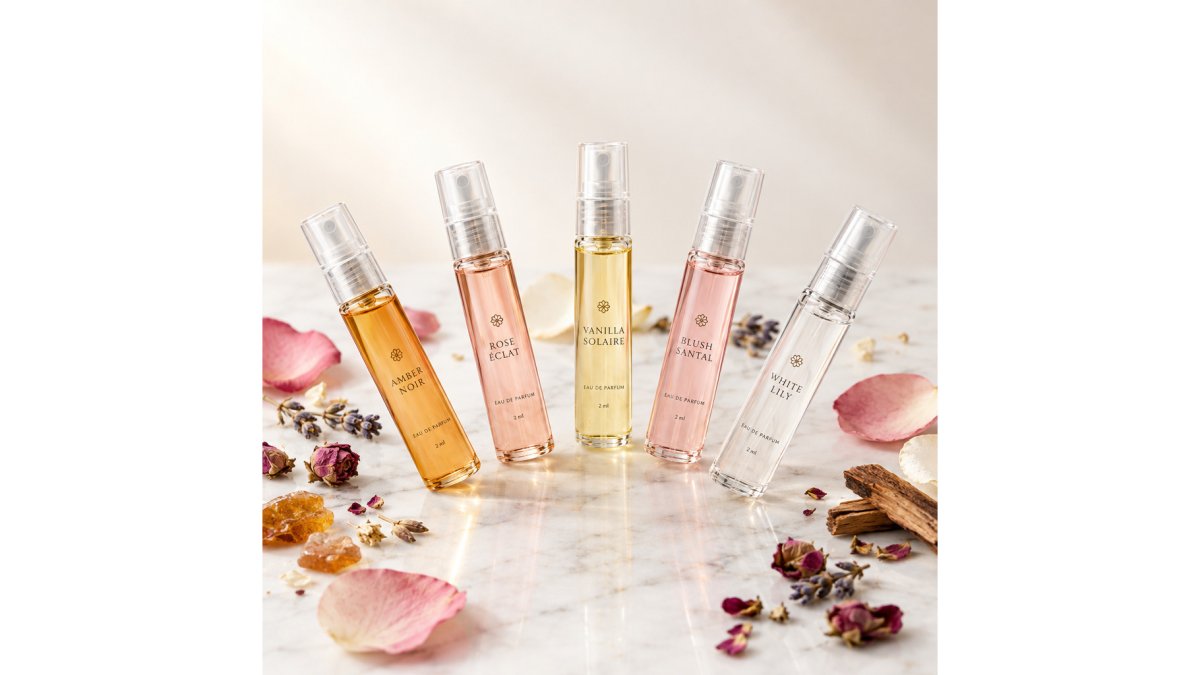
Start with a sample or discovery set. Fragrance Galore offers sample sets with multiple fragrances in smaller sizes, perfect for testing without committing to full bottles.

Apply to pulse points where skin is warmest, wrists, inner elbows, neck, or behind the ears. Heat helps the fragrance bloom and develop.
Wear the fragrance for a full 8-12 hours. Document what you notice:
- How does it smell in the first 15 minutes?
- What changes after 1-2 hours?
- How does it smell at midday?
- What remains at the end of the day?
Take notes. Don't rely on memory. Write down your impressions while they're fresh.
Wait at least 2-3 days before testing another fragrance so your nose can reset. Test too many in one day and olfactory fatigue means you won't smell anything accurately.
Fragrance Discovery Set – 5 Artisan Scents | Sample & Find Your Signature →
Test each fragrance at least twice before deciding. Mood, diet, stress, and weather all affect how you perceive scent, so one bad day shouldn't eliminate a fragrance.
Skin Chemistry and Why Scents Change on Your Skin
Your skin has a unique pH balance, oil production, and bacterial composition. These factors create your personal skin chemistry. Fragrance molecules interact with your skin in ways they don't with anyone else's.
This is why a scent smells different on every person. The same fragrance that smells floral and light on your friend might smell warm and spicy on you. Neither of you is wrong. Your skin chemistry is simply different.
Several factors influence skin chemistry:
- pH level: Acidic skin can make fragrances smell sharper. Neutral or slightly alkaline skin might bring out sweeter notes.
- Hydration: Dry skin holds fragrance differently than oily skin. Hydrated skin typically projects fragrance better.
- Diet: Eating spicy foods, garlic, or certain herbs can subtly influence how fragrance smells on you.
- Hormones: Hormone levels fluctuate throughout your cycle and affect skin chemistry. A fragrance might smell different depending on where you are in your cycle.
- Temperature: Warm skin projects fragrance more. Cold skin can make scents seem muted.
This is why testing on your skin matters far more than smelling from a bottle or paper strip. A paper strip shows you what the fragrance smells like in isolation. Your skin shows you what it actually smells like on you.
How to Make Perfume Last Longer and Project Better
Once you've found your signature scent, you want it to last. Fragrance longevity depends on concentration, application technique, and skin preparation.
Fragrance concentration determines how long a scent lasts:
Application technique matters more than most people realize. Apply fragrance to warm pulse points, not cold areas. Your wrists are good. Your neck is better. Behind your ears is excellent.
Don't rub your wrists together after applying fragrance. This breaks apart the fragrance molecules and speeds up the dry-down. Just let it sit.
Skin preparation affects how long fragrance lasts. Moisturized skin holds fragrance better than dry skin. Apply an unscented moisturizer to your pulse points before applying fragrance.
Consider layering. Many people apply a fragrance-free body oil first, then spray their signature scent on top. This simple technique can extend longevity by 2-3 hours.
Budget-Smart Discovery and Avoiding Purchase Regret
Full-size bottles of quality fragrance cost money. This is why testing before buying matters so much.
Start with discovery sets or sample packs. Fragrance Galore offers a 5-piece discovery set with smaller sizes of multiple fragrances.

Sample sets include multiple fragrances. The math is clear: samples are the smarter choice when you're still exploring.
Many sample sets include credits toward full bottles.
Keep notes on every fragrance you test. Rate them. Write down what you loved and what didn't work. After testing 5-10 fragrances, patterns emerge.
When you're ready to buy a full bottle, you'll know exactly what you want. You'll have worn it multiple times. You'll understand how it behaves on your skin.
Common Mistakes When Choosing a Signature Scent
Most people make the same mistakes when choosing fragrance. Knowing these helps you avoid them.
Mistake 1: Judging based on the opening alone. Top notes last 5-15 minutes.
Mistake 2: Buying full-size bottles without testing. Testing on paper or in-store testers isn't enough.
Mistake 4: Ignoring seasonal variation. A fragrance that smells perfect in winter might feel too heavy in summer.
Mistake 5: Not considering longevity. A fragrance that lasts 2 hours might not work for your lifestyle. If you're at work for 8 hours, you need something with staying power. Check the fragrance concentration before buying.
Mistake 6: Expecting immediate love. Sometimes a fragrance grows on you. It might not wow you on day one.
Mistake 7: Buying based on price alone. Expensive doesn't always mean better.
Finding your signature scent takes time and patience, but it's worth the effort.
Start with a sample set from Fragrance Galore. Test multiple fragrances across different days.
Frequently Asked Questions
What is a signature scent, and why should I have one?
A signature scent is a fragrance that becomes uniquely associated with your identity and personal style. It's a perfume or cologne you reach for consistently because it aligns with your personality, lifestyle, and preferences. Having a signature scent creates a lasting impression on others, boosts your confidence, and becomes part of how people remember you. Unlike trend-driven fragrances you wear occasionally, your signature scent feels like an extension of yourself.
How long should I wear a perfume before deciding if it's right for me?
Test each fragrance for at least 3-5 full days before deciding. A single wear isn't enough to experience how a scent develops on your skin. Fragrance notes evolve throughout the day. Wearing it across different occasions, times of day, and even seasons helps you understand the full scent profile and whether it truly suits your lifestyle.
How do fragrance notes for beginners work, and what should I look for?
Fragrance notes are the individual scent components that make up a perfume. Top notes are the first impression you smell, usually citrus, fruity, or fresh scents that fade quickly. Heart notes (also called middle notes) emerge after 5-15 minutes and form the core of the fragrance, typically floral, spicy, or herbal. Base notes are the lasting foundation, lingering for hours, usually woody, amber, or vanilla scents. For beginners, start by identifying which note family appeals to you most, then explore fragrances built around that family.
Why does my perfume smell different on me than it did in the store?
Skin chemistry plays a major role in how fragrance develops on your body. Factors like your skin's pH level, natural oils, body temperature, and even your diet influence how a scent smells and how long it lasts. A fragrance that smells fresh and citrusy on a test strip might smell warmer and more sensual on your skin due to your unique chemistry. This is why testing on your actual skin over multiple days is essential, it reveals how the fragrance truly performs on you, not just how it smells in the bottle.


