
Last Updated: October 28, 2026
Quick Summary
Perfume oil typically lasts longer on skin than alcohol spray because the oil base slows evaporation and anchors the fragrance to your skin chemistry. A spray often fades within a few hours, while a concentrated perfume oil can hold its base notes well into the day, though it projects more quietly.
- Alcohol spray lifts top notes fast and loud, while oil holds scent close and stretches the dry-down.
- Run a like-for-like test: spray one wrist, oil the other, and check at one, four, and eight hours.
- Apply oil to clean, lightly moisturized skin and dab on pulse points without rubbing.
- Start with two roll-on passes per pulse point; over-applying oil mostly causes nose fatigue.
- Avoid oil on silk, light-colored cotton, leather, and hair, where it can leave residue or stains.
Table of Contents
- Perfume Oil vs Alcohol Spray: The Core Difference
- Does Perfume Oil Last Longer Than Alcohol Spray?
- Perfume Oil Projection and Sillage: Close to the Skin or Across the Room
- How Formula and Concentration Change the Comparison
- How to Apply Perfume Oil for the Best Wear
- How to Layer Perfume Oil and Perfume Without Clashing
- Skin Type, Sensitive Skin, and Climate Considerations
- Choosing Your Format at Fragrance Galore
- Frequently Asked Questions
Perfume Oil vs Alcohol Spray: The Core Difference
The essential difference between perfume oil and alcohol spray comes down to the carrier: perfume oil suspends fragrance molecules in a base oil, while alcohol spray dissolves them in ethanol that evaporates on contact. That single choice shapes how a scent opens, how far it travels, and how long it lingers. Below, we break down the carrier, the wear time, and the application habits that decide the answer.
What the Carrier Does to Your Scent
The carrier is the liquid that delivers fragrance molecules to your skin, and it controls release speed. Alcohol is volatile, so it lifts the top notes into the air fast and loud. Oil is heavier and evaporates slowly, holding the scent close and stretching its dry-down.
That is why an alcohol spray gives you a bright opening within seconds, while a perfume oil unfolds gradually as your body heat warms it. Neither is better in the abstract. The carrier simply changes the fragrance experience you get.
Does Perfume Oil Last Longer Than Alcohol Spray?
Yes, perfume oil typically lasts longer on skin than alcohol spray, because the oil base slows evaporation and anchors the fragrance to your skin chemistry. A spray often fades within a few hours, while a concentrated oil can hold its base notes well into the day. The catch is that this lasting power comes with quieter projection.
A Like-for-Like Wear Test
Apply spray to one wrist and oil to the other at the same time. Check both after one hour, four hours, and eight hours, noting how close you have to lean to smell each. What you will find, in practice, is that the spray announces itself early and fades, while the oil builds slowly and stays. Run this test yourself before committing to a full bottle, since skin chemistry varies from person to person.
Perfume Oil Projection and Sillage: Close to the Skin or Across the Room
Projection is how far your fragrance reaches; sillage is the trail it leaves behind you.
How Formula and Concentration Change the Comparison
When you compare, look at both variables together: carrier and concentration. A concentrated perfume oil and a strong eau de parfum are closer in wear time than a perfume oil and a light cologne. Judge the bottle, not just the label format.
How to Apply Perfume Oil for the Best Wear
Application is where oil and spray diverge most in practice, and the mechanics explain why. Alcohol spray flashes off in seconds, so where you mist matters less than how much you mist. Oil sits on the skin and releases slowly, so placement, skin condition, and dose all change the result. Treat the steps below as a method, not a ritual.
Start With Clean, Moisturized Skin
Apply to skin that is clean and lightly moisturized. Dry skin sheds fragrance faster because there is less surface for the oil to cling to, so a thin layer of unscented lotion applied a few minutes beforehand gives the oil something to hold onto and slows release. Skip heavily fragranced body lotion unless you intend to layer, since it will compete with the scent.
Place, Don't Rub
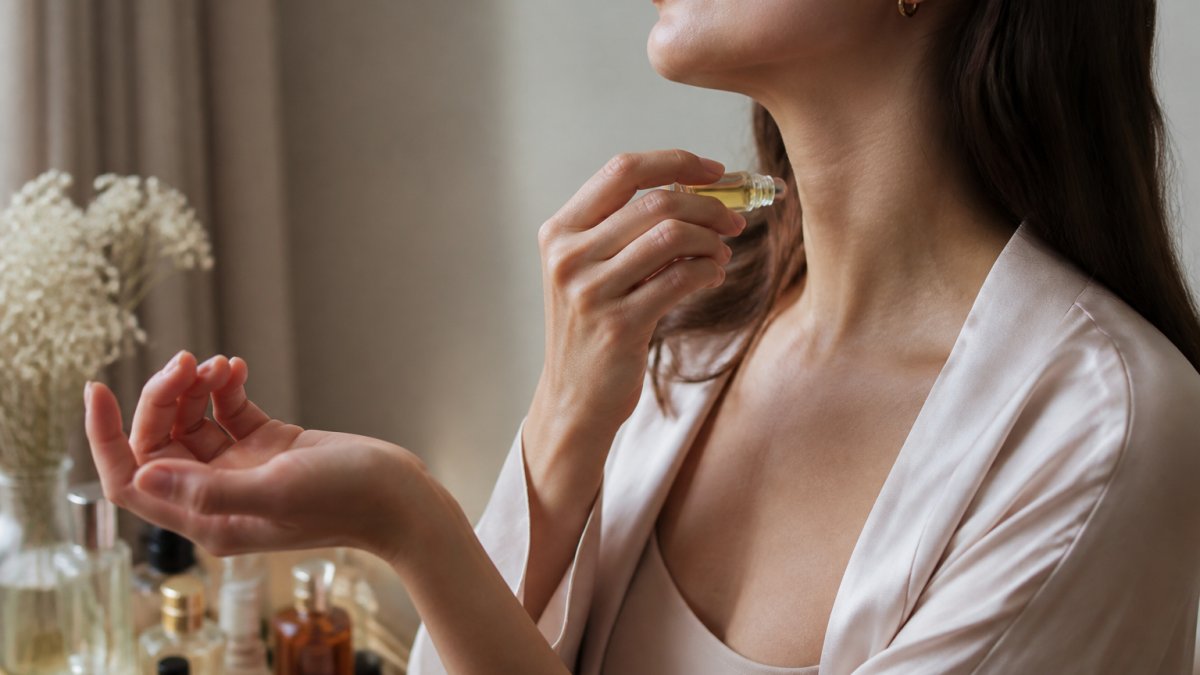
Dab or roll onto pulse points: the inner wrists, the base of the throat, behind the ears, and the inner elbows. These areas are warmer, and body heat helps the oil unfold gradually. Do not rub your wrists together after applying. Friction and heat crush the top notes and push the fragrance toward its base faster, which shortens the opening you paid for. Let the oil sit undisturbed for a few minutes before you judge it; the first sniff is not the finished scent.
Dose by Format, Not by Habit
A roll-on delivers a small, controlled amount per pass, so two passes per pulse point is a reasonable starting dose. A splash or dropper bottle delivers far more per application, so start with a single drop per point and build. Over-applying oil does not increase projection the way an extra spray does; it mostly increases the chance of nose fatigue, where you stop smelling your own fragrance while everyone around you still can.
Where Oil Should and Should Not Go
Oil is forgiving on skin and unforgiving on fabric. On skin, it is fine on pulse points and the décolletage. Avoid broken skin, freshly shaved skin, and the face, where the concentration and the oil base can irritate. On clothing, hair, and surfaces, oil is the riskier format: it can leave a residue or a stain on silk, light-colored cotton, and leather, and it does not evaporate away the way an alcohol mist does. If you want scent on fabric or hair, a spray applied from a distance is the safer choice, and even then test on an inconspicuous area first. Never apply oil to hair you have just washed if you plan to style it, since the residue can weigh strands down.
Perfume Oil, Rose Fragrance Niche Floral Fragrance Fresh And Long-Lasting →
Reapply Lightly, Not Heavily
Our Vanilla Musk Roll-on Perfume Oil | 0.33 fl oz features warm vanilla supported by musk and muguet, with light fruity touches at the top.

How to Layer Perfume Oil and Perfume Without Clashing
For a deeper walkthrough, our guide on how to layer perfume oils for a signature scent covers pairings in detail. A bundle that includes both an eau de parfum spray and a concentrated oil, like the Lattafa Yara 2 Piece Fragrance Bundle, lets you experiment with both formats side by side.
Skin Type, Sensitive Skin, and Climate Considerations
This is where the oil-versus-spray choice gets personal, and where most guides oversimplify. Neither carrier is universally safer or universally better in heat. What matters is how your skin reacts, what is in the formula, and the conditions you wear it in.
Sensitive Skin and Irritation
Alcohol is a known irritant for some people, especially on reactive or compromised skin, so an alcohol-free oil is often the gentler starting point. But oil is not automatically hypoallergenic. Fragrance compounds themselves, not just the carrier, drive most reactions, and an oil can contain the same allergens as a spray. Essential oils, in particular, are a common source of contact sensitivity (pubmed.ncbi.nlm.nih.gov). The practical rule is the same for both formats: patch test on the inner forearm, wait 24 hours, and watch for redness, itching, or swelling before wearing it widely. Avoid broken skin, freshly shaved skin, and the face with either format. If you have a diagnosed fragrance allergy, check the ingredient list rather than the format label, and favor products that disclose their full composition.
Skin Type
Dry skin sheds fragrance faster in both formats, so moisturizing beforehand helps either one last. Oily skin can sometimes stretch wear time, but it can also amplify a heavy oil. There is no skin type for which one format is universally correct; the useful move is to adjust dose and placement to your skin rather than switching formats on principle.
Climate and Environment
Heat and humidity change how a fragrance behaves. In hot, humid conditions, alcohol evaporates faster and can push projection higher for a shorter window, while oil can feel heavier and smell stronger up close, so apply less. In cold, dry air, both formats fade faster and sit closer to the skin, so moisturizing and reapplying lightly matter more than the carrier choice. Wind and air conditioning accelerate evaporation for sprays in particular. If you live in a climate with wide seasonal swings, owning both formats and rotating them by season is more practical than picking one.
Clothing, Hair, and Surfaces
If you have sensitive skin and want an alcohol-free option, an alcohol-free perfume oil is a sensible starting point, but read the ingredient list and patch test first.
Choosing Your Format at Fragrance Galore
| Priority | Better Format | Why |
|---|---|---|
| Longest wear on skin | Perfume oil | Oil base slows evaporation |
| Room-filling projection | Alcohol spray | Fast evaporation pushes scent outward |
| Sensitive skin | Perfume oil | Often alcohol-free, gentler |
| Bright, fresh opening | Alcohol spray | Volatile top notes lift quickly |
| Office or close quarters | Perfume oil | Stays close to the skin |
| Layering base | Perfume oil | Anchors a spray on top |
Fragrance Galore offers a curated selection of signature and niche perfumes, alongside specialty oils, mists, and hair and body perfumes, to help you discover a signature scent.
Frequently Asked Questions
What is the difference between perfume oil and alcohol-based spray?
Perfume oil suspends fragrance molecules in a carrier oil, so it sits close to the skin and releases scent slowly as your body heat warms it. An alcohol spray dissolves the same kind of fragrance in ethanol, which flashes off within seconds and throws the scent outward in a bright burst. The practical result: oils tend to wear quieter and longer, while sprays open louder and fade faster on most skin.
Does perfume oil last longer than alcohol spray?
On most skin, yes. Because oil evaporates slowly, the fragrance lingers for hours with less of the sharp fade you get once alcohol burns off. Expect a skin-close scent that stays noticeable well into the day. Longevity still depends on concentration, your skin chemistry, and the notes themselves, so a heavy base note like patchouli or amber will always outlast a light citrus top note in either format.
Is perfume oil better for sensitive skin than alcohol-based perfume?
Many people with reactive skin find oil formulas gentler because they skip the drying hit of ethanol. That said, fragrance oils still contain aroma compounds that can irritate some skin, so patch test on your inner wrist and wait 24 hours before full application. If you already know a specific note bothers you, avoid it in either format rather than assuming oil is automatically safe.
Can you layer perfume oil with alcohol-based perfume?
Yes, and it is one of the best ways to build a signature scent. Apply the oil first to pulse points and let it settle for a minute, then mist the spray lightly over clothing or from a distance so the two don't compete. Keep them in the same family, like a vanilla musk oil under a warm amber spray, so the layers blend instead of fighting each other.
The real challenge is not picking a format; it is finding the fragrance that feels like you. Fragrance Galore curates signature and niche scents alongside specialty oils, mists, and hair and body perfumes, each chosen to embody elegance and timeless style. Explore the collection, discover your signature scent, and add to cart with confidence.


